
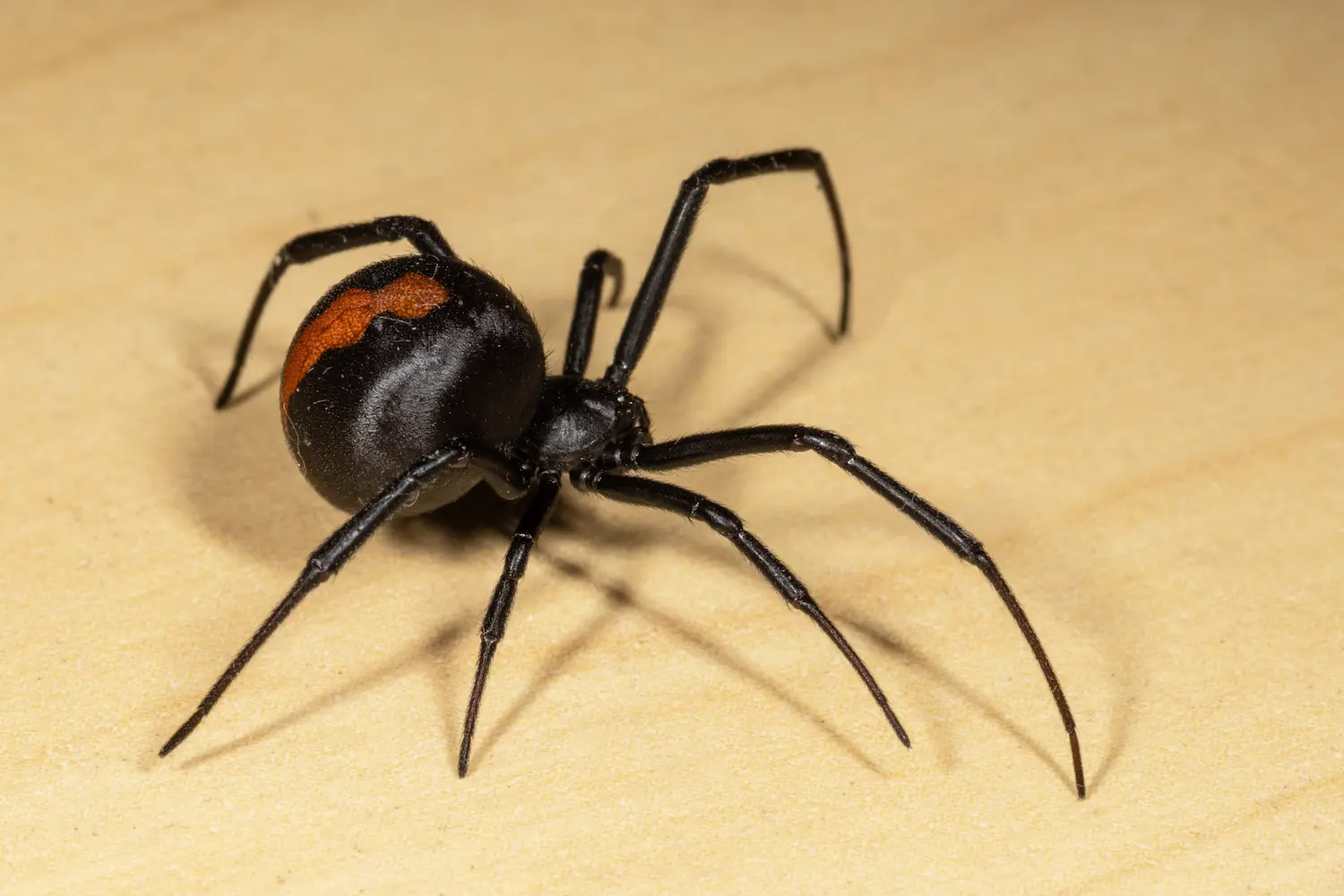
Catching sight of a glossy, pitch-black arachnid bearing a bright red hourglass is enough to make any Inland Northwest homeowner pause. In Eastern Washington and North Idaho, black widows are present but rarely make their presence known. They’re extremely shy and usually can be safely ignored. However, their status as one of the region’s few medically significant venomous pests means that many homeowners seek to eliminate them on first sight.
Key Takeaways:
- Female Western black widows are recognizable by their jet-black bodies and iconic red hourglass markings, while smaller males and juveniles pose no venom threat to humans.
- Population density and human encounters in the Inland Northwest peak from mid-summer through late autumn as hot weather drives spider activity into yards, storage areas, and perimeter structures.
- Homeowners can significantly reduce spider attraction by eliminating ground clutter, managing outdoor storage, clearing perimeter leaf litter, and switching to insect-safe yellow lighting.
- Over-the-counter contact sprays only eliminate individual spiders on direct hit, leaving hidden populations, deep harborages, and protective egg sacs unaddressed.
From the dry basalt outcroppings of the Columbia Basin to the residential neighborhoods of Spokane and the Idaho Panhandle, widow activity surges from mid-summer through late autumn. As warm weather drives families onto patios, into rock gardens, and around woodpiles, understanding how to identify, manage, and prevent these secretive spiders is essential for maintaining a safe property.
Do We Have Black Widows in the Spokane Area?
Yes. The specific species endemic to Spokane, Coeur d’Alene, and the surrounding Columbia Basin is the Western Black Widow (Latrodectus hesperus). Uniquely adapted to the region’s arid summers and freezing winters, Western black widows thrive near human habitations across Kootenai, Spokane, and Benton counties.
Female Western black widows carry the signature glossy black body and red hourglass marking, while smaller males and juveniles feature mottled tan, white, and brown markings that pose no venom threat to humans. Understanding the distinct habits of Latrodectus hesperus helps homeowners identify and target high-risk harborage areas before a population grows.
Are Western Black Widows Dangerous?
Yes, female Western black widows are medically significant, though fatalities are extremely rare thanks to modern medical treatment. Their venom contains a potent neurotoxin called alpha-latrotoxin, which affects the nervous system rather than damaging skin tissue. A bite often feels like a minor pinprick initially, but symptoms—known medically as latrodectism—can develop within one to three hours.
Symptoms may include severe muscle cramps, abdominal pain, chest tightness, nausea, sweating, and elevated blood pressure. While healthy adults typically recover without long-term complications, young children, the elderly, and individuals with underlying heart conditions are at a significantly higher risk for severe reactions and should seek immediate emergency medical care if bitten.
How Can You Prevent Black Widow Spiders on Your Property?
While extermination eliminates active infestations, ongoing spider management relies on environmental modification. You can drastically reduce the likelihood of Western black widows establishing webs around your yard through targeted physical adjustments:
- Elevate and Relocate Outdoor Storage: Stack firewood at least 6 inches off the ground and well away from exterior walls or fence lines. Store patio accessories, plastic bins, and lawn equipment in tightly sealed containers rather than directly on garage floors.
- Adjust Exterior Lighting: Standard porch lights attract flying insects, creating an abundant food supply for web-building spiders. Swap bright white LED or incandescent bulbs for warm yellow LED or sodium vapor fixtures, which attract significantly fewer prey insects.
- Maintain Landscape Buffers: Clear away pine needles, leaf litter, and untended yard debris within 12 to 18 inches of your foundation. Trimming shrubbery and raising lower tree limbs deprives spiders of the dark, humid ground-level harborages they prefer.
- Eliminate Standing Clutter: Remove unused rock piles, landscape timbers, and cardboard boxes from around outbuildings, as these micro-habitats offer ideal shelter for nocturnal arachnids.
What to Do If You See a Black Widow
Despite their reputation, Western black widows are remarkably shy, solitary creatures. They have no interest in hunting humans and will almost always choose retreat over conflict, reserving bites as a last resort when pinched, squeezed, or directly pressed against skin.
If you come across one on your property, basic common sense goes a long way:
- Give it space: Avoid reaching blindly into dark corners, beneath patio furniture, or into unlit storage boxes.
- Wear protection: Throw on a pair of thick leather work gloves before moving stacked firewood, clearing pine needle piles, or handling stored outdoor items.
- Keep distance: Keep young children and curious pets away from active web sites until the area is clear.
- Mark the spot: Take note of the exact harborage location so a pest professional can inspect and address the root of the activity.
Are DIY Removal Methods Effective?
There is a common misconception that DIY treatments are entirely useless against spiders. In reality, direct contact sprays—and even standard aerosol contact killers—will eliminate an individual black widow if you catch it out in the open and land a direct hit.
Where DIY approaches consistently fail is in eradicating a broader, established infestation.
Because Latrodectus hesperus builds webs deep inside dark foundation cracks, basalt rock gaps, wall voids, and dense crawl spaces, off-the-shelf contact sprays simply cannot reach the hidden majority of the population or their protective egg sacs. Furthermore, store-bought aerosols lack the long-lasting residual power needed to kill emerging spiderlings or spiders traveling across treated surfaces weeks later.
Professional control shifts the focus from hunting individual spiders to comprehensive harborage elimination. Pest management specialists utilize microencapsulated residual barriers that adhere to spider legs as they crawl, alongside specialized web-dusting agents that penetrate deep into structural crevices—neutralizing active spiders, egg sacs, and their insect prey across the entire property.
Where Do Black Widow Spiders Like to Hide in the Inland Northwest?
Black widows are shy, nocturnal arachnids that build webs near ground level in dark, undisturbed areas. Across local properties in Eastern Washington and North Idaho, common hiding spots include:
- Basalt rock outcroppings, landscape retaining walls, and stacked firewood piles
- Pine needle debris, leaf litter, and untended yard clutter
- Dark corners of unconditioned garages, detached sheds, and crawl spaces
- Inside irrigation valve boxes, utility meters, and basement vents
- Beneath decks, covered porches, and seasonal patio furniture
- Gaps in brick veneer and foundation cracks along the perimeter of the home
How to Identify Western Black Widow Spiders and Egg Sacs
While the glossy black female with her red hourglass is the most recognizable form of Latrodectus hesperus, identifying these spiders across their life stages—and recognizing their egg sacs—is essential for spotting harborages around your property.
| Identifying Criteria | Visual & Structural Details |
| 1. Female Body Marking | Adult females feature a hairless, jet-black to dark brown body with a distinctive bright red or orange hourglass marking on the underside of the rounded abdomen. |
| 2. Male & Juvenile Markings | Significantly smaller than females, males and immature widows display a light tan to dark brown body with white, yellow, or reddish diagonal stripes and spots along the abdomen. They pose no venom threat to humans. |
| 3. Web Architecture | Messy, unorganized, and tangled irregular webs anchored near ground level. The silk strands are coarse, highly adhesive, and noticeably resistant when pulled, unlike typical orb-weaver webs. |
| 4. Egg Sac Appearance | Smooth, papery, and teardrop-to-spherical in shape, ranging from cream to light tan. Female widows aggressively guard these sacs, which typically measure 1/2 inch in diameter and contain up to several hundred eggs. |
| 5. Size & Structure | Adult females measure approximately 1.5 inches in total length (including leg span) with a plump, spherical abdomen, long legs, and a smooth, glossy exoskeleton lacking visible hairs. |
What to Do If You Get Bit by a Western Black Widow
While bites are uncommon due to their shy nature, accidental contact can happen. If you suspect or know you have been bitten by a Western black widow, remain calm and follow these immediate first-aid steps before seeking professional medical evaluation:
- Clean the Bite Site: Wash the area thoroughly with mild soap and clean water to reduce the risk of secondary bacterial infection.
- Apply a Cold Compress: Place an ice pack wrapped in a cloth or a cold compress over the bite site for 10 minutes at a time to reduce pain and localized swelling.
- Elevate the Limb: If the bite occurred on an arm or leg, keep the limb elevated at or above heart level to help slow the systemic spread of venom.
- Avoid Harmful DIY Tactics: Do not attempt to cut the skin, suck out the venom, or apply a tight tourniquet, as these methods can cause tissue damage and worsen the injury.
- Seek Medical Care: Contact Urgent Care, an emergency room, or Poison Control right away. If it is safe to do so, safely capture or take a clear photo of the spider to confirm the species for medical staff.
Are There False Black Widows in Spokane?
Yes. The Cupboard Spider (Steatoda grossa) and the Boreal Comb-Footed Spider (Steatoda borealis) are common throughout Spokane, the Idaho Panhandle, and the Columbia Basin. Because they belong to the same cobweb weaver family (Theridiidae), false widows share the bulbous abdomen and messy web habits of true widows, often leading to mistaken identity.
Are They Dangerous?
No. False black widows are not medically significant. While a female can bite if squeezed or trapped against skin, the reaction is localized and mild—typically causing minor pain, swelling, and redness comparable to a bee sting. They do not possess the neurotoxic venom (alpha-latrotoxin) that causes systemic illness.
| Identification Feature | Western Black Widow (Latrodectus hesperus) | False Black Widow (Steatoda grossa) |
| Abdomen Color | Glossy, deep pitch-black | Dark purplish-brown, chocolate, or charcoal |
| Underside Markings | Distinct bright red or orange hourglass | No red markings; plain or faint tan underside |
| Dorsal (Top) Markings | Uniform black (adult female); males/juveniles have red/white stripes | Faint cream, purplish, or tan crescent-shaped spots |
| Venom & Health Risk | Medically Significant: Causes neurotoxic muscle cramps and severe pain (latrodectism) | Non-Significant: Minor localized pain and redness (similar to a bee sting) |
| Primary Habitat | Dry outdoor harborages: rock walls, woodpiles, irrigation boxes | Sheltered indoor/outdoor zones: basements, crawl spaces, garages, window wells |
Long-Term Black Widow Protection for Inland Northwest Properties
Living in Eastern Washington and North Idaho means sharing the landscape with Western black widows, but they shouldn’t dictate how you enjoy your outdoor space. Achieving lasting peace of mind requires moving beyond temporary fixes to establish an impenetrable protective envelope around your home.
At Eden Advanced Pest Technologies, we pair deep-harborage inspections with residual treatments designed specifically to withstand the Inland Northwest’s seasonal temperature swings. Our specialized spider control treatments eliminate hidden populations and protective egg sacs, ensuring your living spaces remain safe year-round.
If you suspect Western black widows have established a presence around your property in Spokane, Coeur d’Alene, Post Falls, or the Tri-Cities, contact our team today to request a free estimate or schedule your service.
Back to Spider Exterminators and Control